Summary
What the Lord requires: to act justly, love mercy, and walk humbly with God.
by Dr. David Silver2 min read
Read the Summaryby Dr. David Silver2 min read
Micah is a minor prophet who is one of ‘The Twelve.’ He was a contemporary with Isaiah, prophesying to Judah about 740 B.C. He is mentioned in Jeremiah 26: 17-19 as a prophet during the reign of Hezekiah whom God used to bring about reform and deliverance. Remembering him saved Jeremiah’s life at the time. He is best known for revealing the birthplace of the Messiah (5: 2). His name means, ‘Who is a God like you,’ which he uses as a word play in the end of the book (7: 18). There are three main divisions in the book: chapters 1-2 deal with the judgment of Israel and Judah and restoration of a remnant; chapters 3-5 focus on indictment of Judah’s leaders and future hope; chapters 6-7 discuss God’s charges against Judah and triumph of God’s kingdom.
He prophesied destruction of both Samaria, the capital of the northern kingdom of Israel (1: 5-7), which happened in 722 B.C., and the destruction of Jerusalem, the capital of Judah in the south (1: 9-16), which occurred in 586 B.C. Those who plan iniquity, plot evil, and covet will not get away with it. The Lord is planning disaster (2: 3). Micah rebukes the false prophets in 2: 6-11. Despite this, God will bring together a remnant (2: 12-13).
The prophets and Judah’s leaders go astray yet feel God will not allow any disaster to befall them (3: 11). But because of them Jerusalem will become a heap of rubble (3: 12). Micah warns them they will go to Babylon (4: 10) and simultaneously gives them hope that they will walk in the name of the Lord our God forever and ever (4: 5). The Lord will make a remnant and will rule over them in Mt. Zion forever (4: 7). Not only will the Messiah come out of Bethlehem, but his origins are from of old (5: 2). He will shepherd his flock in the strength of the Lord as his greatness will reach to the ends of the earth. And he will be their peace (5: 4-5).
God brings a case against his people (6: 1-2). He has delivered them out of Egypt. Cold religion is not what God is looking for (6: 6-7). Then Micah gives well-known counsel to his people. Instead, Israel remained in their guilt and was liable to punishment (6: 9-7: 7). Jesus quotes Micah 7: 6 in Matthew 10: 35-36. There is no other God like him. He is forgiving and shows mercy. He has compassion and hurls our iniquities into the depth of the seas (7: 18-19).
Structure
Chapters 1–2
Samaria and Jerusalem both fall under sentence; those who scheme on their beds will be caught, and yet God will gather a remnant.
Chapters 3–5
Rulers, priests and prophets all for sale; Zion will be plowed as a field — and out of Bethlehem will come one whose origins are from of old.
Chapters 6–7
What does the Lord require? Not more sacrifice but justice, mercy and humility — and the book ends asking who is a God like You, pardoning iniquity.
Key Themes
01
Corrupt leaders, dishonest scales, and the Lord’s case against them.
02
God has shown you what is good; the question is whether you will do it.
03
God preserves a people through the judgment.
04
A shepherd-king from a small town, whose greatness reaches to the ends of the earth.
05
God hurls our iniquities into the depths of the sea.
The Challenge We Face
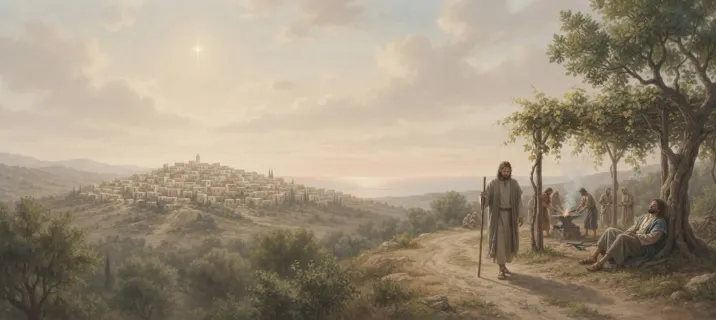
When Herod asks where the Messiah is to be born, the scribes answer from Micah: Bethlehem Ephrathah, small among the clans of Judah.
Micah adds that His origins are from of old, from ancient days, and that He will shepherd His flock in the strength of the Lord — and that He Himself will be their peace.
Apply Scripture
God has already told you what He requires; the difficulty is doing it.
Leaders who profit from their position are answerable for it.
Religious activity cannot substitute for justice and mercy.
God works through small places and overlooked people.
He delights in showing mercy, and He does not keep our sins.

Study guides
You've seen the big picture. Now explore the book verse by verse with our practical Bible Study Guide.
Related Resources