Summary
Israel's story retold for the returning exiles, centred on worship and David's line.
by Dr. David Silver3 min read
Read the Summaryby Dr. David Silver3 min read
1 Chronicles and 2 Chronicles were originally one book but were divided due to scroll length. These books are at the end of the Hebrew scriptures but cover the same history as Samuel and Kings. They answer the question: Where do we go from here? After the exile, the Messianic hope came into focus through the line of David. Also, temple worship would be important. Therefore, Judah took precedence over the northern kingdom of Israel. The author may have been Ezra, but since it is not definite, the author is known as the Chronicler.
The first nine chapters of 1 Chronicles were genealogies, connecting Adam (the first word of the book) to post-exilic Judah. The source of these genealogies was mostly the book of Genesis. After discussing King Saul in chapter 10, the rest of the book (chapters 11-29) highlights the life of King David. Several negative stories are omitted (running from Saul, Bathsheba) and instead David is portrayed in a more positive light with additional new material about his preparations for the temple.
The Chronicler connects Adam to Noah, and then Shem (Noah’s son) to Abraham. Abraham’s concubine’s (Hagar and Keturah) children are listed. Then Sarah’s (Abraham’s wife) child Isaac is mentioned. Isaac had Esau and Jacob (Israel). Chapter 1 ends with the listing of Esau’s genealogy. Chapter 2 begins with Israel’s sons-twelve in all and their families. Judah is first in priority. King David’s family is discussed in chapter 3, along with the kings that come from that line through his son Solomon.
In chapter 6, the Levite line is expounded, as the temple service is paramount in the post-exilic community. The rest of the tribes are delineated and are connected to the kingship by inserting Saul’s line in chapter 8.
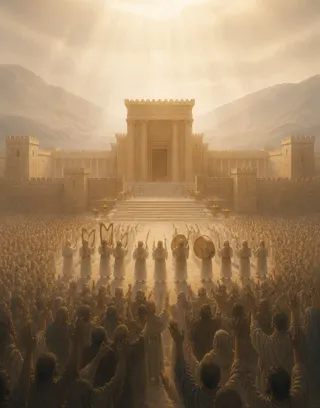
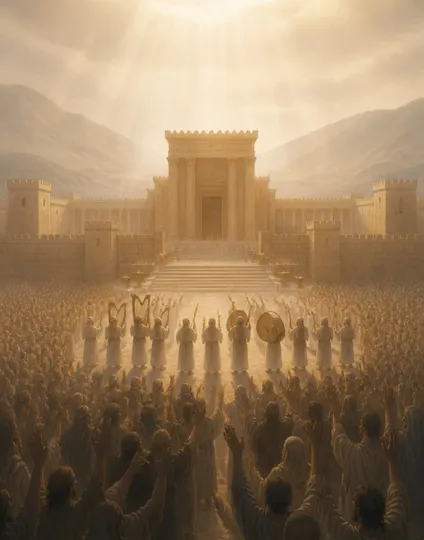
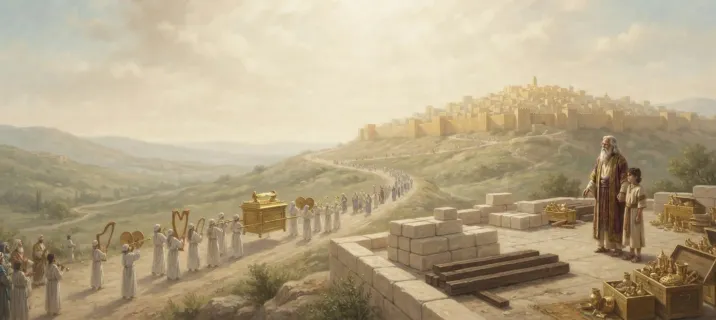
After David was over Judah for seven years, he united the nation by becoming king over all Israel for thirty-three more years. He conquered Jerusalem and made it the capital of Israel. He had brave warriors and mighty men lead his powerful army. He defeated the Philistines (1 Chronicles 14: 16) and all the nations feared him. He brought the ark to Jerusalem and wrote a psalm of thanksgiving (taken from Psalms 105, 96, and 106). He organized musicians and the priesthood to serve in the temple.
In chapter 17 (similar content to 2 Samuel 7), David desires to build the temple for the Lord. Nathan relays the Lord’s message back to him: The Lord will build a house for you (1 Chronicles 17: 10). God promises to establish his throne forever, which is a Messianic promise.
Satan incited David to take a census of the fighting men in Israel. This command was evil in the sight of God, so he punished Israel by sending a plaque. Seventy thousand men died. David interceded by making a sacrifice after buying the threshing floor and land of Araunah. He realized this was to be the site of the temple.
After making his son Solomon king, he made multiple preparations for the temple. He organized the Levites and divisions of priests in chapters 23-24. He also set apart some to be singers, gatekeepers, other officials, and army officers in chapters 25-27. In chapter 28 he gives a charge to Israel’s officials, like Moses, Joshua, and Samuel had done at the end of their lives. He donated very generously to the preparatory work of the temple and prayed in the last chapter (28). Solomon is acknowledged as king again. The book closes with the death of David.
Structure
Chapters 1–9
From Adam to the families that came back from exile, with Judah, David’s line, and the Levites given pride of place.
Chapter 10
Saul’s death is told briefly, as the failure that clears the way for David.
Chapters 11–21
Jerusalem taken, the ark brought up with music and thanksgiving, God’s promise of an everlasting house, and the census that locates the temple site.
Chapters 22–29
David gathers materials, organises priests, Levites, singers and gatekeepers, charges Solomon and the nation, gives generously, and dies.
Key Themes
01
A people rebuilding after exile are shown who they are and where they came from.
02
More space is given to singers and temple servants than to battles.
03
The Messianic hope is kept in view for a nation with no king.
04
David gives out of his own treasure, and the people follow.
05
David spends his last years making ready a work he will not see finished.
The Challenge We Face
The genealogies are not filler; they are a line being traced, and the New Testament picks the same line up and carries it to Jesus.
God’s word to David that He will establish his son’s throne forever is quoted in Hebrews and applied to Christ. A book written for people with no king on the throne is holding the door open for the king who was coming.
Apply Scripture
Knowing where you came from steadies you when everything else is uncertain.
Worship is not the decoration around the work; it is the work.
Preparing well for those who come after you is a real ministry.
Generosity is led from the front.
God’s promises hold through exile and silence.

Study guides
You've seen the big picture. Now explore the book verse by verse with our practical Bible Study Guide.
Related Resources