
Summary
The beginning of creation, humanity, and God's covenant plan.
by Dr. David Silver4 min read
Read the Summaryby Dr. David Silver4 min read
Moses is writing on the plains of Moab (outside the Promised Land) before his death to answer this question in the Torah (Pentateuch-first five books in Old Testament): How did Israel get here? Genesis, which means beginning, is the first of this genre. Genesis is divided into ten books, all starting with the phrase ‘toledot’ (These are the generations of). The first eleven chapters cover primeval history. The rest of the book covers the history of the Patriarchs-Abraham, Isaac, Jacob, ending mostly with Joseph’s story.
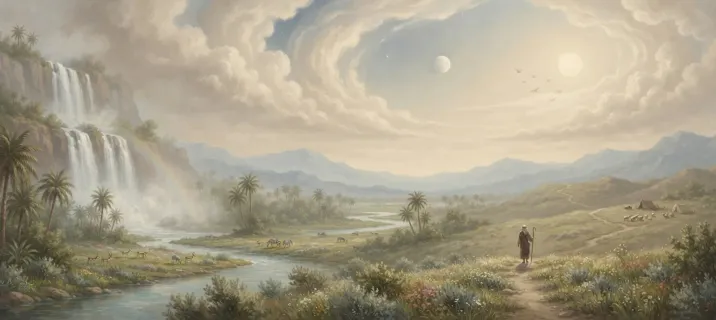
The story of creation assumes God’s existence, as God is mentioned in the first verse without explanation. He is the Creator. Everything he created was good, except it was not good for the man to be alone. So, after God created Adam, he made Eve from Adam’s rib. He put them in the garden to work and gave them a Sabbath rest once a week.
After receiving the command from God not to eat from one tree (the tree of the knowledge of good and evil), the serpent (Satan, the devil, spoke through the serpent) came into the garden to tempt them to disobey. Eve was deceived, while Adam passively went along with his wife, and they fell into sin. God restored them by covering them with animal skins (the first atonement, which means covering). God gave consequences to the couple and the serpent and pronounced the first gospel in Genesis 3:15. This was a Messianic promise.
Sin, which had come into the world, began to wreak havoc. Cain killed his brother Abel (Genesis 4:8). Lamech boasts about killing a man (Genesis 4:23-24). “The Lord saw how great man’s wickedness on the earth had become, and that every inclination of the thoughts of his heart was only evil all the time (Genesis 6: 5).” God chose Noah to build an ark to preserve a remnant through the flood that was coming to destroy the earth. Only Noah and his family survived. God established a covenant with them after the flood and gave the rainbow as a sign that he would not destroy the earth with water like that again.
Man began to multiply again through Noah’s sons, and with a common language some began to build a tower in Babel. Since they were doing it for their own glory, God scattered them from there and confused the language of the whole world. While most of mankind continued to go astray from the Lord, God called Abram to follow him.
God was determined to bless (bless is a key word in Genesis and is found eighty times) Abraham (his name got changed to ‘father of many nations’). After many trials including famine, rescuing his nephew Lot after he was kidnapped, struggling with infertility, having a son Ishmael with his mistress Hagar, Abraham finally had his son Isaac with Sarah his wife. Then God told him to sacrifice Isaac when he was thirteen. Abraham was ready to do that, but God stopped him as it was a test. It was also a picture of the gospel since God would sacrifice his One and only Son Jesus Christ on the cross.
Isaac’s story is virtually skipped as Isaac struggles to walk closely with the Lord. God provides a wife for him through answered prayer, but he also deals with famine, infertility and trouble trusting in the Lord’s word that his older twin Esau would serve the younger twin Jacob. Finally, Jacob decides to deceive his father to get the blessing.
Jacob must run for his life. Esau was not happy about not getting the blessing or losing his birthright for a bowl of stew and was considering killing Jacob. Unfortunately, Jacob goes to live with his uncle Laban, who is even more deceitful than himself. He works seven years to get his wife Rachel (whom he loved) but is tricked by Laban (the bride’s father) and given her sister Leah instead. He then worked for another seven years for Rachel. Counting maidservants, Jacob ends up with four wives and twelve children, the twelve tribes of Israel (Jacob’s name is changed to Israel after he wrestles with the Lord-Genesis 32:24).
Jacob favors Joseph, his first son with Rachel. He gives him a multicolored coat. When the opportunity comes, his jealous brothers sell him to Egyptians. However, God blesses him wherever he goes including Potiphar’s (Pharoah’s Captain of the Guard) home and prison (Joseph was falsely accused of rape by Potiphar’s wife). Eventually, Pharoah has two dreams which Joseph can interpret, and he becomes Prime Minister under Pharoah. Later he reveals himself to his brothers. He forgives them and brings his family to Egypt to help them during the years of famine.
Jacob blesses his twelve sons before he dies. Judah, who had learned through his own trials, is meant to be the tribe where kings reside. Indeed, the Messiah would come from this line. Joseph dies and his coffin is placed in Egypt. He made his brothers take an oath that they would carry his bones to the Promised Land since he foresaw the Exodus.
Structure
Chapters 1–11
Creation, the Fall, the Flood, and the Tower of Babel introduce humanity’s relationship with God and the spread of sin throughout the world.
Chapters 12–25
God calls Abraham, establishes His covenant, and promises to bless all nations through his descendants.
Chapters 26–36
God’s covenant continues through the next generation, revealing His faithfulness despite human conflict and failure.
Chapters 37–50
Joseph’s story demonstrates God’s providence as He preserves His covenant people during famine and suffering.
Key Themes
01
God is the sovereign Creator of heaven and earth.
02
Human rebellion brings sin and death into creation.
03
God initiates a lasting relationship with His people through gracious promises.
04
God calls His people to trust His promises even when circumstances seem impossible.
05
God works through ordinary and difficult circumstances to accomplish His purposes.
The Challenge We Face
Although written long before the birth of Jesus, Genesis prepares the way for the coming Messiah.
From the promise that the offspring of the woman would crush the serpent to God’s covenant with Abraham and Joseph’s role as a suffering deliverer, the book consistently points forward to God’s ultimate plan of redemption fulfilled in Christ.
Apply Scripture
God remains faithful to His promises even when His people fail.
Trust God’s sovereignty in seasons of uncertainty.
Obedience often begins with taking one faithful step.
God’s plan of redemption unfolds throughout every generation.
Faith grows through trusting God’s promises rather than our circumstances.
Study guides
You've seen the big picture. Now explore the book verse by verse with our practical Bible Study Guide.
Related Resources


Still Have Questions?
Genesis has traditionally been attributed to Moses, who is also associated with the other books of the Pentateuch.
Genesis reveals God as Creator and introduces His plan of redemption through covenant, demonstrating His faithfulness despite humanity's sin.
Genesis lays the theological foundation for the rest of Scripture by introducing creation, sin, covenant, and God's promise of salvation.
Yes. The summary provides a foundation, while the Study Guide helps you explore the text more deeply through structured questions and practical application.