Summary
God's unseen hand preserving His people through the courage of one woman.
by Dr. David Silver3 min read
Read the Summaryby Dr. David Silver3 min read
Esther is the last scroll in a series of five known as the Megilloth. These scrolls were read at Jewish Festivals; Esther was read at the Feast of Purim. It was the best-known book of the OT for the ordinary Jew, since its triumphal story of Jews prevailing was a much-needed encouragement. Its author is unknown. Its story takes place in Persia, after the Babylonian exile, about twenty years prior (478 B.C.) to Ezra’s arrival in Jerusalem. After King Cyrus, a Persian king, conquered Babylon (539 B.C.), he decreed the Jews to return to their homeland. However, many did not return but remained in Persia. This book describes their plight. God is not mentioned in this book (or Song of Songs), but his providence is evident.
After King Darius died, his son King Xerxes took the throne (his Hebrew name was King Ahasuerus). He reigned in the citadel of Susa. He gave a great banquet (there are ten in this book). His wife, Queen Vashti also gave a banquet for the women in the royal palace (Esther 1:9). When King Xerxes ordered his Queen to come before him, she refused. She was deposed and another was sought to replace her. In chapter 2, Esther (also known as Hadassah), who was a Jew, was picked to become queen. Her cousin who had raised her was Mordecai. The chapter ends with Mordecai uncovering a conspiracy to kill the king. It was recorded in the book of the annals.
Chapter 3 begins with Haman (an Agagite) being honored and elevated to the second highest position in the kingdom. At the city gate all the royal officials would bow down to Haman, but Mordecai refused. Haman decided to kill all Mordecai’s people rather than him alone. The lot was cast (or the pur) in the presence of Haman to determine when the Jews should be killed (Esther 3: 7). Haman manipulated King Xerxes to make an edict to annihilate the Jews on the day chosen.
When Mordecai learned of the decree, he and the rest of the Jewish people mourned and wept. When Esther sent a messenger to find out what was happening, Mordecai sent a message to Esther to plead with the king for her people. When she hesitated due to the risk, he sent another message. She asked the Jews to fast for three days and decided to approach the king.
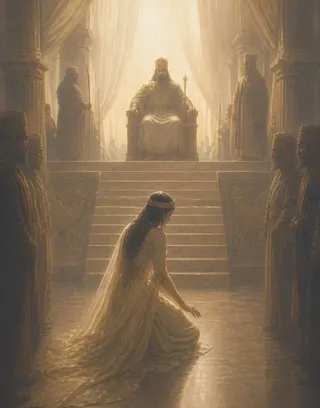
When she did, the king extended to her the golden scepter (one could be killed for approaching the king uninvited unless he held out this scepter). She invited the king and Haman to a banquet, waiting for the right time to discuss this matter. They joined her for the banquet. The king asked again what her request was, but she asked them to come to another banquet the next day.
In the meantime, Haman saw Mordecai again, who continued not to pay him homage. With the advice of his wife and friends, he made a gallows to hang Mordecai. That night the king could not sleep, and he had the book of the annals read to him; he discovered that Mordecai had not been rewarded for saving his life. In an ironic twist, Haman came to see the king to ask permission to kill Mordecai but instead ended up leading Mordecai on a horse through the streets to honor him.
The king and Haman went to Esther’s banquet later that day where she told the king what Haman had done. The king hung Haman on the gallows and made Mordecai his second in command. Esther was given Haman’s estate. Another edict went out which Esther and Mordecai wrote protecting the Jews and allowing them to defend themselves when the time came. There was immense joy and celebrating among the Jews, and many people of other nationalities became Jews because fear of the Jews had seized them (Esther 8: 17). No one could stand against the Jews and they defeated their enemies. Purim became a festival to commemorate these events. Mordecai was held in high esteem as he worked for the welfare of his people (Esther 10: 3).
Structure
Chapters 1–2
Xerxes deposes Vashti; Esther is chosen queen and keeps her people secret, and Mordecai uncovers a plot against the king.
Chapters 3–4
Haman, enraged that Mordecai will not bow, buys an edict to annihilate the Jews; Mordecai tells Esther she may have come to the kingdom for such a time as this.
Chapters 5–7
Esther risks her life to approach the king and invites him and Haman to two banquets; a sleepless night, a public honour for Mordecai, and Haman hanged on his own gallows.
Chapters 8–10
A second edict lets the Jews defend themselves, their enemies fall, and the Feast of Purim is established to remember it.
Key Themes
01
God is never named in the book and is behind every page of it.
02
Esther acts knowing it may cost her life.
03
Every scheme recoils on the schemer; the gallows built for Mordecai take Haman.
04
A hidden Jewish identity becomes the thing on which a nation’s survival turns.
05
For such a time as this — position is given for a purpose.
The Challenge We Face
Esther stands between her people and a death sentence they cannot escape, goes uninvited into the king’s presence at the risk of her life, and says, if I perish, I perish.
That is the shape of what Christ does, without the risk being hypothetical. And the preservation of the Jewish people here keeps alive the line through which the Messiah would come.
Apply Scripture

God is at work even where He is never mentioned.
The position you hold may be for a purpose you have not seen yet.
Courage usually looks like one frightening step taken anyway.
Evil schemes have a way of turning back on themselves.
Remembering what God has done is worth building into the calendar.

Study guides
You've seen the big picture. Now explore the book verse by verse with our practical Bible Study Guide.
Related Resources