Summary
Israel asks for a king, and God looks instead at the heart.
by Dr. David Silver3 min read
Read the Summaryby Dr. David Silver3 min read
The books of 1 Samuel and 2 Samuel were one book until the Septuagint (Greek version of the OT written between 3rd and 1st centuries B.C.) separated them. These books were connecting the time of the judges to the establishment of the monarchy in Israel. 1 Samuel is thought to have be written after Solomon died. The author is unknown, though Samuel may have been a contributor.
The first seven chapters review the birth and life of Samuel, who was considered the last judge and establisher of the prophetic office. The request of having a king in Israel begins in chapter 8, and Samuel anoints Saul as king in chapter 9. The rest of the book is about King Saul’s life until his death in the last chapter (31). Halfway through the book, in chapter 15, Saul is rejected as king due to disobedience. In the next chapter, David is anointed by Samuel to be the next king, though it does not actually happen for many years. In chapter 17, David defeats Goliath and his rise begins.
Samuel’s mother, Hannah, prayed for a child and then dedicated him to God after he was weaned. Samuel went to live in the temple under the high priest Eli. The Lord called Samuel in chapter 3, and he shared with Eli the negative prophecy explained to him. Eli failed to discipline his disobedient sons, and all three (Eli and two sons) die the same day after the Philistines capture the ark.
Samuel begins to lead Israel as its judge and prophet and turns the nation back to the Lord (1 Samuel 7: 2-4). The Philistines were subdued (1 Samuel 7:13). When Samuel became old, and his sons were disobedient (like Eli’s), the elders asked him for a king. Samuel anointed Saul as king (1 Samuel 10: 1). Saul rescued the city of Jabesh and then was confirmed as king in 1 Samuel 11: 15. Saul was thirty years old when he became king, and he reigned for forty-two years. Early on in his reign, there were signs that Saul was not fully faithful. He offers up a burnt offering instead of waiting for Samuel like he was instructed (1 Samuel 13: 9-10). Saul is ready to kill his son Jonathan for eating honey after he gave a foolish command to his army not to eat that day (Jonathan was unaware of the command). Then he was given orders by the Lord to annihilate the Amalekites, but instead he leaves the king and many sheep alive.
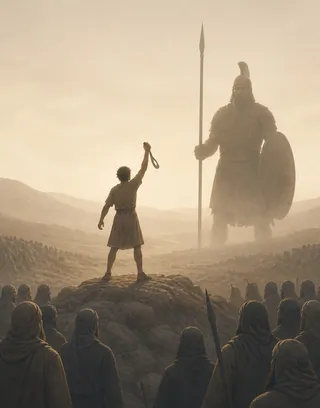
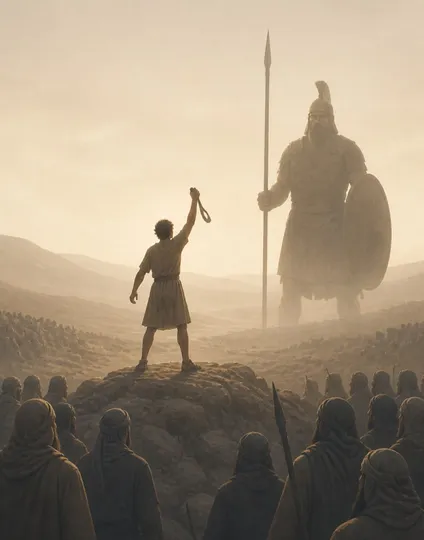
Samuel is sent to anoint David as the future king (1 Samuel 16: 1). David became armor-bearer and player of the harp for King Saul, though he knew nothing of David’s anointing. When a battle began with the Philistines, a giant named Goliath came out to taunt the armies of Israel. When David stumbled onto the battlefield on an errand, he heard the taunts and decided to fight Goliath. David defeated Goliath with a slingshot and stone and then cut his head off after killing him.
In time, Saul became jealous of David and tried to kill him several times. David was forced to run for his life and became a fugitive. David became good friends with Jonathan, Saul’s son, who warned him of his father’s bad intentions. After David got some help from the priests at Nob, Saul found out about it and slaughtered eighty-five priests along with the whole town of Nob. Saul continued to pursue David for years, yet David spared his life twice when he had opportunity to kill King Saul.
David had also married Michal, Saul’s daughter, and later Abigail. He also married other women and had many children. He fled out of the country to hide from Saul on more than one occasion and almost fought against Israel with the Philistines. When the time came, the Philistines did not trust David and asked him to leave the battle. Meanwhile, Saul, reached out for help to a witch at Endor (chapter 28). Samuel was called up from the dead and he told Saul that he and his sons would die the next day in battle. It happened just as he said.
Structure
Chapters 1–7
Hannah’s prayer, the boy called in the night, the fall of Eli’s house, and a last judge who turns the nation back to the Lord.
Chapters 8–15
Israel demands a king like the nations; Saul is anointed, begins well, and is rejected for disobedience.
Chapters 16–20
Samuel anoints a shepherd boy, David kills Goliath, and Saul’s jealousy turns murderous.
Chapters 21–31
David runs for years, spares Saul’s life twice, and Saul dies on Mount Gilboa after consulting a medium.
Key Themes
01
The book opens with a woman’s prayer and turns on it.
02
To obey is better than sacrifice; Saul loses the kingdom over that lesson.
03
People look at appearances; God looks at the heart.
04
Saul’s fear of losing his place destroys him from the inside.
05
David is anointed king and then waits years, refusing to seize what God promised.
The Challenge We Face
Hannah’s song of the God who lifts the lowly and brings down the proud is taken up almost line for line by Mary in Luke.
David — anointed but not yet reigning, rejected, hunted, and refusing to take the throne by force — is the clearest Old Testament picture of the king who would come from his line and wait on His Father’s timing.
Apply Scripture

God hears prayers prayed out of grief.
Partial obedience is disobedience.
God does not evaluate people the way we do.
Jealousy will consume whoever keeps it.
Waiting for God is not passivity; it is trust.

Study guides
You've seen the big picture. Now explore the book verse by verse with our practical Bible Study Guide.
Related Resources